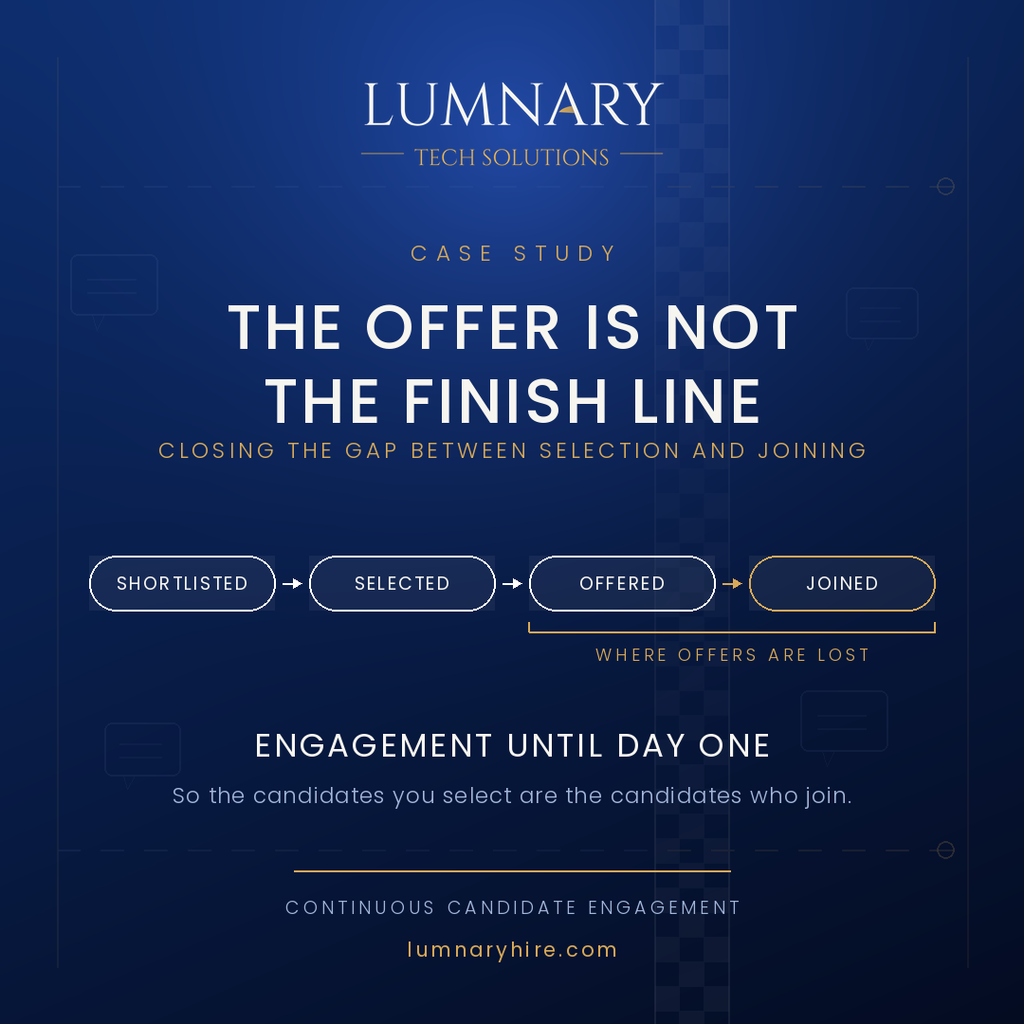
How Lumnary Tech Solutions reduced candidate drop-offs by treating the period after the offer as part of the hiring process — not the end of it.
Every hiring team has lost a candidate they had already won.
The interviews went well. The offer was extended and accepted. Then, somewhere in the weeks that followed, the candidate stopped replying to emails, delayed submitting documents, or sent a short message two days before the start date to say they would not be joining.
The role reopens. The process restarts. The team runs short for another two months.
This is the most expensive form of hiring failure, because every rupee and hour of effort has already been spent. And in most cases, it was preventable.
Why Candidates Drop Off
Drop-off is rarely a single dramatic decision. It is usually the result of a quiet gap that nobody filled.
They lose interest. Enthusiasm peaks at the offer and decays with every week of silence that follows. A candidate who hears nothing for three weeks is no longer the same candidate who accepted.
They accept another offer. Strong candidates are rarely in one process. An offer in hand often accelerates other conversations rather than ending them.
They receive a counter-offer. Resignation triggers a retention response from the current employer — and the candidate weighs it with no one from your side in the conversation.
They delay documentation. Paperwork slips when nobody is following up, and a delayed document becomes a delayed start date, which becomes an opening for second thoughts.
They go unresponsive. Sometimes the decision has already been made, and silence is simply how it gets communicated.
They have an unresolved concern. A question about role scope, location, or compensation goes unasked because there is no obvious person to ask — so it resolves itself as a withdrawal.
The common thread: almost every one of these is a communication gap, not a compensation problem.
What We Changed
Most recruitment processes treat communication as a scheduling function. Candidates hear from someone when an interview needs to be booked, and otherwise sit in silence.
Lumnary Tech Solutions replaced that with continuous candidate engagement, running from the first screening conversation through to the day the candidate reports.
Engagement from screening, not from offer
- Contact established at the initial screening stage, not after selection
- Expectations on role, compensation, location, and timelines set early and honestly
- A single, consistent point of contact throughout — no handoffs between stages
- Candidates always told what happens next and when, even when the answer is “we are waiting”
Active coordination at every stage
Our team took ownership of the full communication chain:
- Interview schedules — arranged, confirmed, and reconfirmed
- Candidate availability — tracked and matched against panel calendars
- Interview feedback — chased actively and relayed promptly, in both directions
- Offer communication — explained clearly, with questions answered properly
- Documentation — requested early, followed up, and verified before it could delay anything
- Joining dates — confirmed and aligned between both sides
- Pre-joining follow-ups — maintained through the entire notice period
A communication bridge, not a messenger
Where concerns arose between candidate and client, we did not simply pass messages along. Our team worked to identify the real issue and move it toward a practical resolution.
This matters more than it sounds. Candidates rarely raise a concern directly with a prospective employer — the power imbalance discourages it. They will raise it with a recruitment partner. That makes us the only party positioned to hear a problem while it is still solvable.
Managing the notice period deliberately
The weeks between resignation and joining are where offers are lost. We treated them as an active phase:
- Regular contact maintained rather than waiting for the start date
- Counter-offer situations identified early, while there was still room to respond
- Hesitation detected through engagement patterns, not discovered on day one
- Joining logistics confirmed well in advance
The Outcome
Stronger candidate engagement Candidates stayed invested in the process because they were never left guessing where they stood.
Smoother conversion at every stage The progression from shortlisted → selected → offered → joined became more predictable, with fewer losses at each handover point.
Issues surfaced early Concerns reached us while they could still be addressed, rather than arriving as a withdrawal.
Reduced rework for the client Fewer drop-offs meant fewer reopened roles, fewer repeated interview cycles, and less time lost to restarting closed searches.
A better candidate experience Even candidates who were not selected experienced a professional, communicative process — which protects the client’s employer brand and keeps those candidates open to future roles.
Why Continuous Engagement Works
- Silence is interpreted, not neutral. Candidates fill an information vacuum with the least favourable explanation available.
- Engagement is cheaper than replacement. A ten-minute check-in costs a fraction of restarting a search.
- Concerns are only solvable while they are concerns. Once a candidate has decided to withdraw, you are negotiating against a conclusion, not a question.
- The notice period is a live phase, not a waiting period. Treating it as dead time is how accepted offers become declined ones.
Key Takeaways for Hiring Teams
- Measure drop-off, not just time-to-hire. A fast process that loses candidates at the offer stage is not a fast process.
- Assign ownership of the post-offer period. If nobody is named, nobody is doing it.
- Expect the counter-offer. It is routine, not exceptional, and it should be anticipated rather than reacted to.
- Chase documentation early. Paperwork delays are rarely about paperwork.
- Keep communicating with candidates you reject. Today’s near-miss is often next quarter’s hire.
Losing Candidates Between Offer and Joining?
We manage candidate engagement across the full hiring cycle from first screening through to day one so that the candidates you select are the candidates who join.