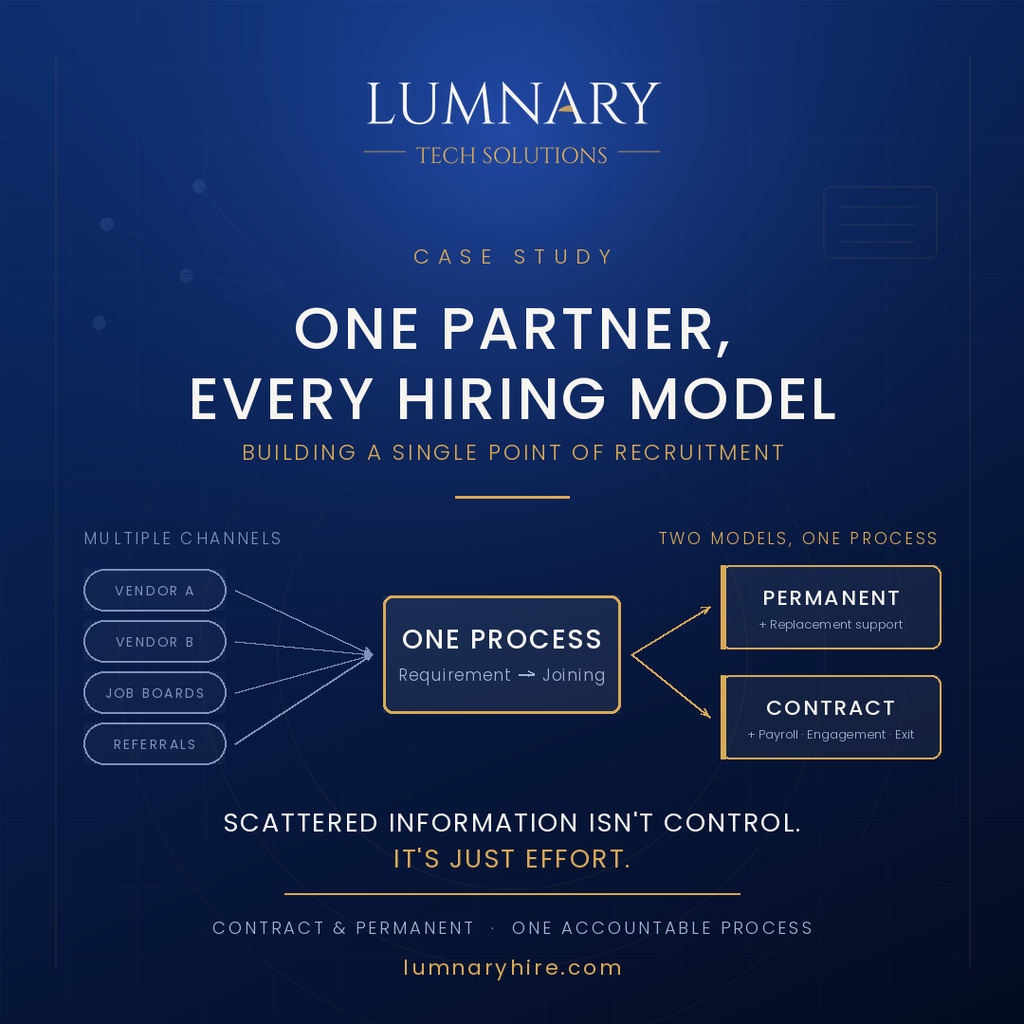
How Lumnary Tech Solutions became an extended recruitment function for a client scaling across contract and permanent hiring.
Recruitment gets harder as it grows, but not in the way most people expect.
Hiring for one role is a sourcing problem. Hiring for twelve roles across two engagement models, with different vendors handling different parts, is a coordination problem — and coordination problems scale worse than sourcing ones.
That was the position this client reached. Requirements were increasing. Recruitment was running through multiple channels. And the internal team was spending more time managing the channels than evaluating the candidates coming through them.
What Breaks When Hiring Scales Across Channels
Consistency disappears. Different vendors screen to different standards. One sends five relevant profiles; another sends forty of mixed quality. The hiring team absorbs the difference as extra filtering work.
Coordination multiplies. Every additional channel adds a separate set of follow-ups, feedback loops, documentation threads, and joining confirmations — each with its own cadence and its own contact.
Visibility fragments. When different parties hold different pieces of the pipeline, nobody can answer simple questions — how many candidates are at offer stage, which roles are at risk, where the bottleneck sits.
Nobody owns the gaps. Problems that fall between vendors tend to sit there, because resolving them is not clearly anyone’s job.
The client did not need more recruitment capacity. They needed one accountable process that could handle several hiring models without changing shape.
What We Built
Lumnary Tech Solutions acted as an extended recruitment function — managing requirements from first conversation about the vacancy through to candidate deployment.
The core process, applied to every requirement
Requirement Understanding → Talent Sourcing → Screening → Shortlisting → Interview Management → Feedback & Follow-up → Documentation → Joining
The same stages, the same ownership, and the same standard applied to every role regardless of function or seniority. That consistency is what made hiring predictable rather than dependent on which channel a requirement happened to go through.
For contract manpower, the process extended further
Contract engagements carry an operational tail that permanent hiring does not, so we additionally managed:
- Payroll for deployed resources
- Candidate engagement throughout the assignment
- Issue resolution during the contract term
- Exit management at the close of the engagement
For permanent positions, the process extended differently
- Replacement support within the agreed three-month period, so early attrition did not return the client to the starting line
Two hiring models, one process, with the specialised handling each one actually requires layered on top.
The Outcome
A centralised recruitment partner. One organisation accountable for every requirement, across both hiring models.
Reduced coordination effort. Scheduling, follow-ups, feedback collection, documentation, and joining administration consolidated into a single relationship rather than spread across several.
Greater visibility. With the full pipeline running through one process, the client could see status across all open roles in one place rather than assembling it from multiple sources.
Greater control, not less. This is the part clients are often sceptical about. Consolidating recruitment with one partner sounds like handing over control. In practice, a single process produced clearer visibility than managing several channels did — because information that is scattered is not control, it is just effort.
Our Recruitment Value Proposition
We believe recruitment does not end when a CV is shared. We take responsibility for the complete candidate journey.
Permanent Recruitment
Source → Screen → Shortlist → Interview → Feedback → Documentation → Joining → Replacement Support
Contract Staffing
Source → Technical Screening → Selection → Joining → Payroll → Candidate Engagement → Issue Resolution → Exit
Our strength lies in combining talent acquisition with continuous candidate management and operational support — so clients get a hiring partner, not a CV supplier.
Key Takeaways for Growing Teams
- Count your coordination load, not just your vendor count. Every additional channel adds follow-ups, not just candidates
- Consistency of screening is worth more than volume of profiles. Variable standards push filtering work back onto your team
- Different hiring models need different handling, not different partners. Contract and permanent diverge after selection, not before it
- Visibility is the real test. If you cannot see your full pipeline in one place, you are coordinating rather than controlling
Scaling Your Hiring?
We manage contract and permanent recruitment under one process — from requirement to joining, with payroll and engagement for contract staff and replacement support for permanent hires.