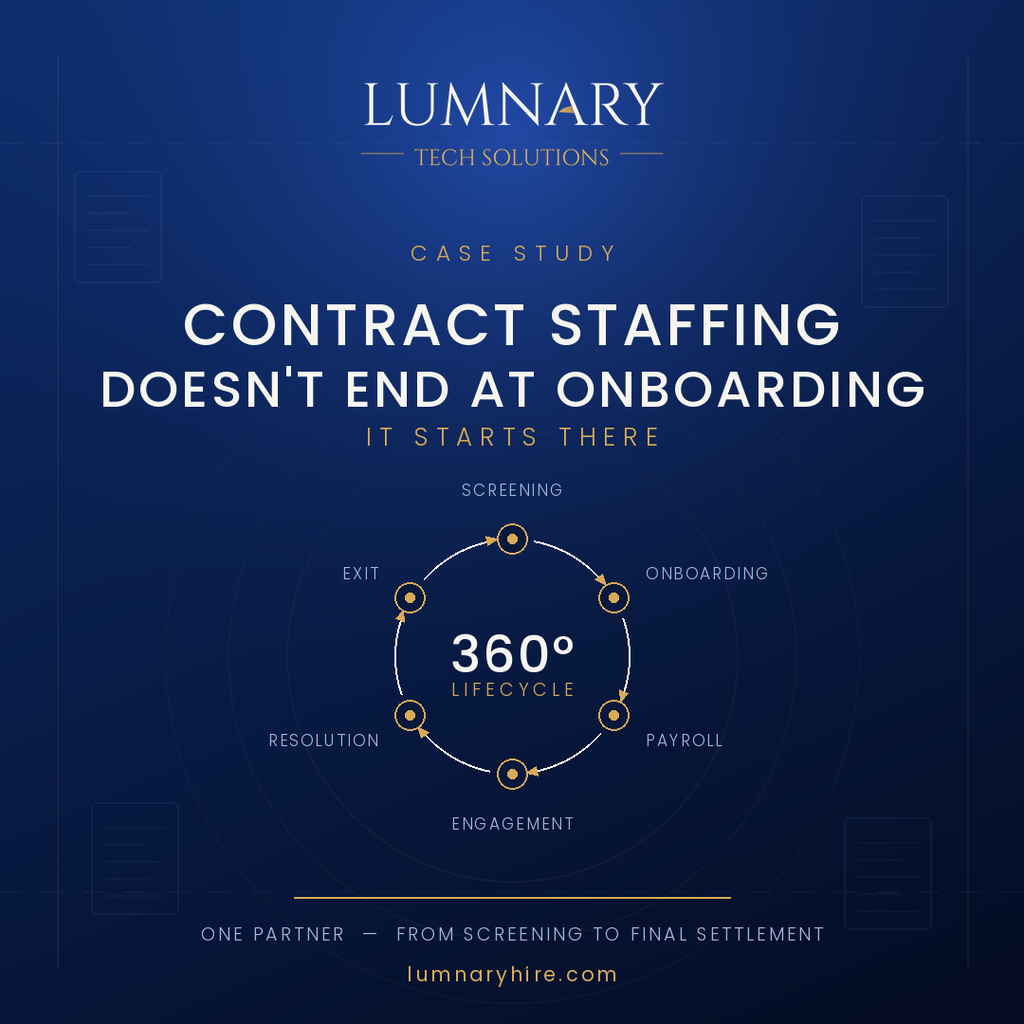
How Lumnary Tech Solutions took ownership of the full 360° candidate lifecycle for a contract staffing client: screening, payroll, engagement, and exit.
Most staffing conversations end at the same place. The candidate accepts, the invoice goes out, and the recruitment partner moves on to the next requirement.
For the client in this case study, that was precisely the problem. They did not need someone to find people. They needed someone to stay responsible for them.
Contract staffing carries an operational tail that permanent hiring does not. Someone has to run payroll accurately, every cycle. Someone has to be reachable when a deployed resource has a question about their payslip, their leave, or a difficulty at the client site. Someone has to notice when an engagement is drifting before it becomes a resignation. And someone has to close the assignment cleanly when the contract term ends.
When no single partner owns all of that, it lands back on the client’s internal team by default.
What the Client Actually Needed
The brief was not a sourcing brief. It was a management brief.
- A technically screened workforce, not a list of available candidates
- A single point of accountability for every deployed resource
- Payroll ownership, including accuracy, timeliness, and query resolution
- Active engagement through the assignment, not silence after joining
- A reliable escalation route when issues surfaced at the site
- Clean exit coordination at the close of each contract term
Put simply, they wanted a manpower-management partner, not a CV vendor.
Where Contract Staffing Usually Breaks
Three failure points show up repeatedly in contract engagements, and all three sit after the placement.
Payroll becomes the relationship
Nothing damages a deployed resource’s confidence faster than a payroll error. A late payment, an unexplained deduction, or an unanswered query does not stay a finance issue — it becomes an engagement issue within days, and an attrition issue within weeks.
For contract staff, payroll is the employment experience. Handled well, it is invisible. Handled poorly, it is the only thing they think about.
Deployed resources go unmanaged
A candidate placed on a client site sits between two organisations and often belongs to neither. If the staffing partner disengages after joining and the client treats them as external, the resource has nobody to raise a concern with.
Small, solvable problems — a clarification about scope, a scheduling conflict, an unclear reporting line — are left to grow instead.
Exits are improvised
Contract terms end. That is the nature of the engagement. But when nobody owns the closure, final settlements get delayed, handovers happen informally, and documentation goes incomplete. A resource who might have returned for a future assignment leaves with a poor last impression instead.
What We Built: The 360° Candidate Lifecycle
Lumnary Tech Solutions took responsibility for the complete engagement cycle, structured into clear stages with defined ownership at each.
Technical screening and evaluation Candidates were assessed against the client’s technical requirements before reaching them — validating hands-on capability rather than keyword-matching profiles, so interview time was spent on evaluation rather than filtering.
Coordination and selection We managed scheduling, follow-ups, and feedback through the selection process, keeping candidates informed at every stage and the client free of coordination overhead.
Joining and onboarding support We coordinated documentation, joining formalities, and site readiness, and stayed in contact through the notice period — the window where contract candidates most often drop off.
Payroll management We took full ownership of payroll for deployed resources:
- Accurate, on-time processing each cycle
- Clear, accessible payslips and records
- A direct route for any payroll query, resolved by us rather than routed to the client
- Compliance and documentation maintained throughout the assignment
Continuous engagement Deployed resources were not left to themselves after day one. Regular check-ins kept us aware of how each assignment was progressing — and surfaced concerns early, while they were still small.
Client–candidate coordination We sat between both parties as the working interface: relaying expectations, clarifying scope, and keeping communication consistent in both directions.
Issue resolution When challenges surfaced during an assignment — site-level, administrative, or personal — we owned the resolution rather than escalating it back to the client’s team.
Contract completion and exit coordination As assignments closed, we managed the exit:
- Handover coordination with the client
- Final settlement and documentation
- A clear, professional closure for the resource
- Feedback captured for future deployments
Smooth closure of the engagement Every assignment ended deliberately, not by expiry — leaving both the client and the resource in a position to work together again.
The Outcome
A single accountable partner The client dealt with one organisation across the entire candidate journey — screening, joining, payroll, engagement, and exit — instead of coordinating between a recruiter, a payroll provider, and their own internal team.
Reduced operational workload Payroll processing, query handling, issue resolution, and exit administration moved off the client’s plate entirely.
A better experience for the deployed workforce Contract staff had a consistent point of contact from the first conversation to the final settlement, which showed in how they engaged with their assignments.
Fewer surprises Continuous engagement meant concerns reached us early, while they could still be resolved — rather than arriving as a resignation.
Why Single-Partner Ownership Works
- Accountability has nowhere to hide. When screening, payroll, and engagement sit with different parties, every problem falls into the space between them.
- Payroll accuracy is a retention strategy. It is treated as an administrative function, but for contract staff it is the single strongest signal of whether they are valued.
- Engagement prevents replacement. A mid-assignment exit costs far more than the check-in that would have prevented it.
- Clean exits build a returning talent pool. Resources who leave an assignment well are the fastest hires for the next one.
Key Takeaways for Organisations Using Contract Staffing
- Judge a staffing partner by what they do after the placement, not before it.
- Ask who owns payroll queries. If the answer is “the client,” you have taken on an operational function you did not budget for.
- Unmanaged resources are at-risk resources. Nobody to talk to means problems surface as departures.
- Plan the exit at the start. Contract engagements end by design; the closure should be designed too.
Looking for a Contract Staffing Partner?
We manage contract staffing end to end — technical screening, onboarding, payroll, engagement, and exit so your team manages delivery instead of administration.