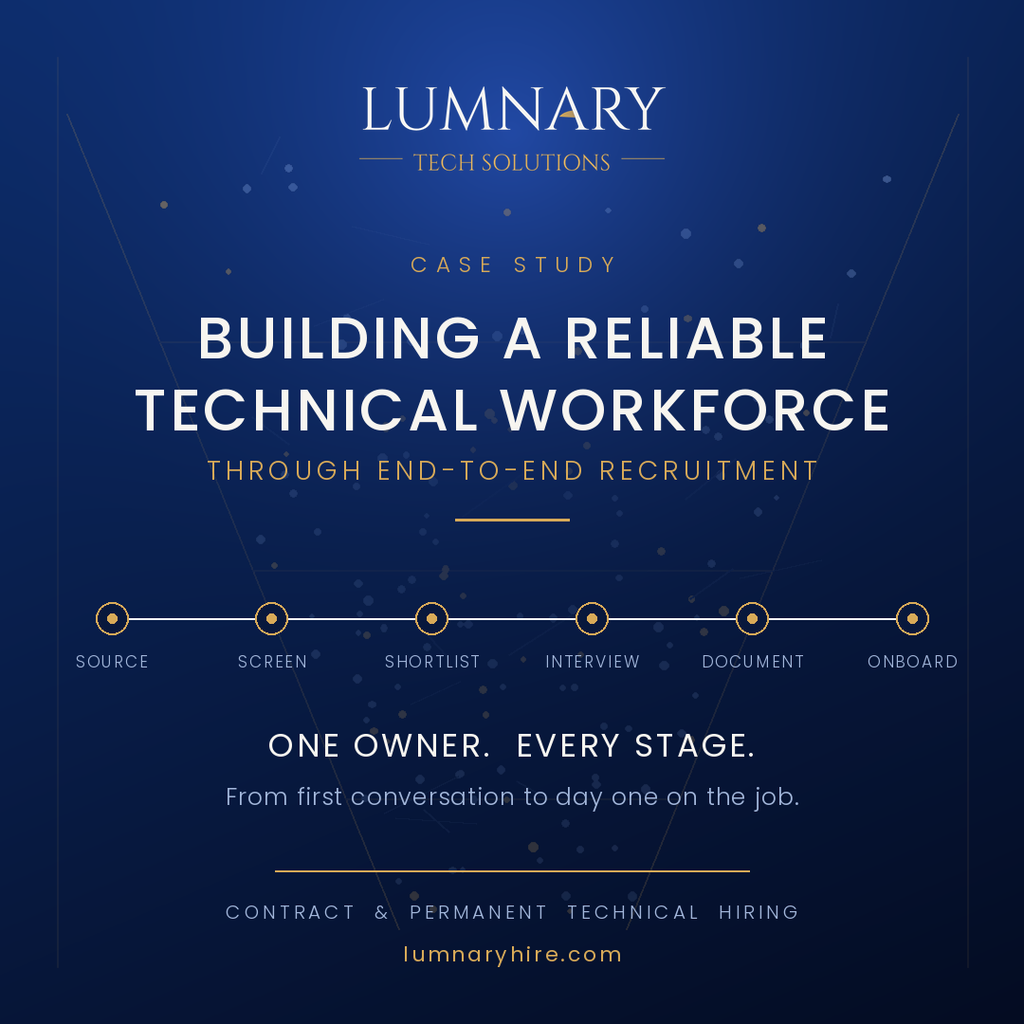
How Lumnary Tech Solutions took ownership of a client’s full hiring cycle — from role definition to day one on the job and gave their internal team its time back.
At a Glance
| Client | [Industry / company type — e.g. enterprise technology services organisation] |
| Engagement | End-to-end technical recruitment |
| Scope | Sourcing, screening, interview coordination, documentation, onboarding |
| Roles hired | [Role families — e.g. cloud engineering, QA, data] |
| Duration | [Engagement period] |
The Challenge
Hiring technical talent is rarely a sourcing problem alone. For this client, the difficulty was less about finding people and more about the volume of coordination sitting between a good profile and a joined employee.
Their internal team was carrying the full weight of the process:
- Screening at scale. Reviewing large volumes of profiles to identify the small number with genuinely relevant technical depth — time taken directly from delivery and engineering work.
- Interview logistics. Aligning candidate availability with panel calendars across multiple rounds, then rescheduling when either side moved.
- Feedback chasing. Collecting evaluations from interviewers already stretched across project commitments, often days after the interview itself.
- Candidate follow-ups. Keeping applicants informed and engaged through a process with unavoidable waiting periods.
- Documentation and joining. Collecting, verifying, and tracking candidate paperwork ahead of start dates.
The compounding effect mattered more than any single task. Every day added to the cycle increased the risk of losing a strong candidate to a faster-moving offer and in a competitive technical market, the best profiles are rarely available for long.
The core issue: the client’s team was spending its time administering recruitment rather than evaluating talent.
Our Approach
Lumnary Tech Solutions assumed complete ownership of the recruitment cycle, operating as an extension of the client’s team rather than as an external vendor working at arm’s length.
1. Understanding the requirement properly
Before sourcing began, we invested in getting the brief right:
- Worked directly with hiring managers to understand the technical stack, seniority expectations, and delivery context of each role.
- Distinguished must-have skills from nice-to-have skills — the single most common reason shortlists miss the mark.
- Clarified engagement terms, working models, and time zone expectations up front, so these never surfaced as late-stage surprises.
- Established what a strong profile looked like in practice, not just on paper.
2. Targeted sourcing and shortlisting
- Sourced across multiple channels rather than relying on a single database or job board.
- Assessed profiles against the agreed technical criteria, not keyword matches.
- Presented a curated shortlist with context on each candidate — relevant project experience, availability, and expectations.
- Kept the pipeline warm so replacements were ready if a candidate withdrew.
3. Initial technical screening
- Conducted first-round technical screening before profiles reached the client.
- Validated hands-on depth in the specific technologies each role required.
- Assessed communication and stakeholder-readiness, particularly for client-facing and lead positions.
- Filtered out profiles that read well but did not hold up under technical questioning — the step that most directly protected the client’s interview time.
4. Interview coordination and management
- Scheduled interviews across candidate and panel availability, including across time zones.
- Managed rescheduling, reminders, and confirmations end to end.
- Followed up on interviewer feedback to keep decisions moving.
- Communicated outcomes to candidates promptly, whichever direction they went.
5. Documentation and verification
- Collected all required candidate documentation.
- Verified completeness and accuracy ahead of submission.
- Flagged gaps early, rather than at the point they would delay a start date.
6. Onboarding and joining coordination
- Coordinated the joining process with both candidate and client.
- Stayed in contact through the notice period — the window where offer drop-offs most often occur.
- Confirmed successful reporting on day one.
7. Continuous candidate communication
Throughout the cycle, candidates had a single, consistent point of contact. Silence during a hiring process is the fastest way to lose a strong candidate, and keeping them informed protected both the pipeline and the client’s employer brand.
The Outcome
By managing the recruitment process end to end, Lumnary Tech Solutions delivered results across four dimensions:
A lighter administrative load The client’s internal team stepped out of scheduling, chasing, and documentation entirely, and redirected that time to delivery work.
A more structured hiring process Defined stages, clear ownership, and consistent follow-through replaced an ad hoc process that depended on whoever had capacity that week.
Sharper focus on evaluation The client’s team engaged only with pre-screened, technically validated candidates — spending their interview time on assessment rather than filtering.
A stronger candidate experience Consistent communication and reliable coordination meant candidates stayed engaged through the process and reported successfully on their start dates.
Why This Model Works
End-to-end ownership succeeds where task-based recruitment support does not, for three reasons:
- Accountability sits in one place. When sourcing, screening, and coordination are split across parties, delays fall into the gaps between them. Single ownership removes those gaps.
- Context compounds. A partner who has understood the technical brief screens more accurately with every role, rather than starting fresh each time.
- Candidates experience one process, not several. A consistent point of contact from first conversation to day one materially reduces drop-off.
Key Takeaways for Hiring Teams
- Screening time is engineering time. Every hour a technical lead spends filtering profiles is an hour not spent on delivery.
- Speed is a competitive advantage. In technical hiring, the strongest candidates are typically off the market within weeks.
- The offer-to-joining window is the highest-risk stage, and the one most often left unmanaged.
- Coordination quality shapes employer brand. Candidates judge an organisation by how it runs its hiring process including the ones who do not get an offer.
Work With Lumnary Tech Solutions
We partner with organisations that need technical talent hired reliably, without the coordination load falling on their internal teams whether that is a single specialist role or an ongoing hiring programme.